iOS vs Android vs Cross-Platform: Choosing the Right Mobile App Strategy for Your Business

iOS vs Android vs Cross-Platform: Choosing the Right Mobile App Strategy for Your Business
Every founder building a mobile app eventually hits the same question: build native, or build cross-platform? Get it wrong, and you either overspend on two separate native codebases you didn't need, or you ship a cross-platform app that feels sluggish and never quite matches the polish users expect.
This guide breaks the decision down honestly — including where cross-platform tools genuinely fall short, and where they're the obviously smarter choice.
The Three Paths, in Plain English
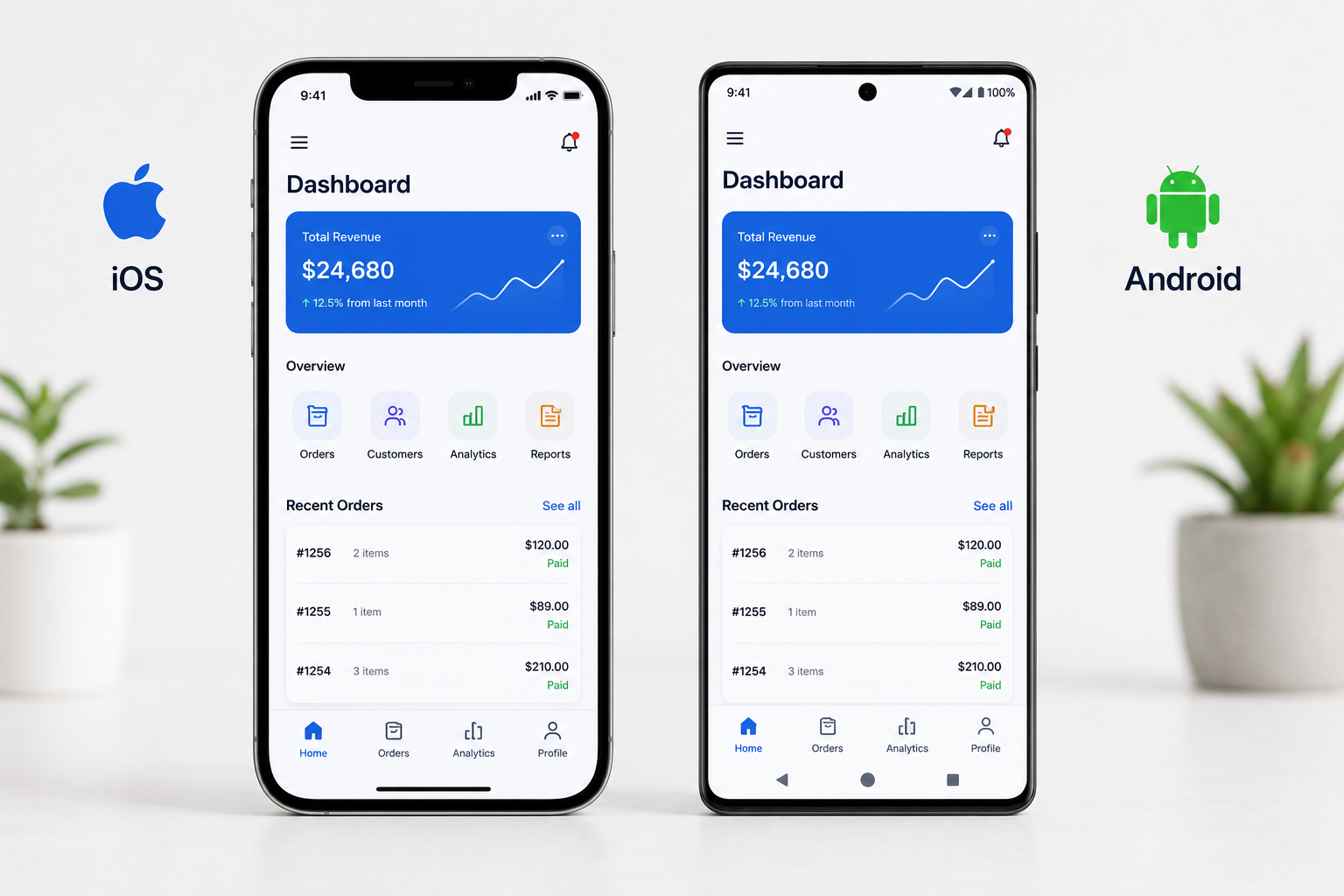
Native iOS (Swift/SwiftUI) — built specifically for Apple's ecosystem. Maximum performance and access to every iOS-specific feature (Face ID, Apple Pay, widgets, Live Activities) the moment Apple ships it.
Native Android (Kotlin) — built specifically for Android. Same benefits, but for the far larger and more device-fragmented Android install base.
Cross-platform (React Native / Flutter) — a single codebase that compiles to both iOS and Android, sharing the vast majority of business logic and UI code between platforms.
Cost and Speed: Where Cross-Platform Wins
The single biggest driver toward cross-platform development is economics. Maintaining two fully separate native codebases means:
Two development teams (or one team context-switching between two languages)
Two sets of bugs to fix for every feature
Two release cycles to coordinate
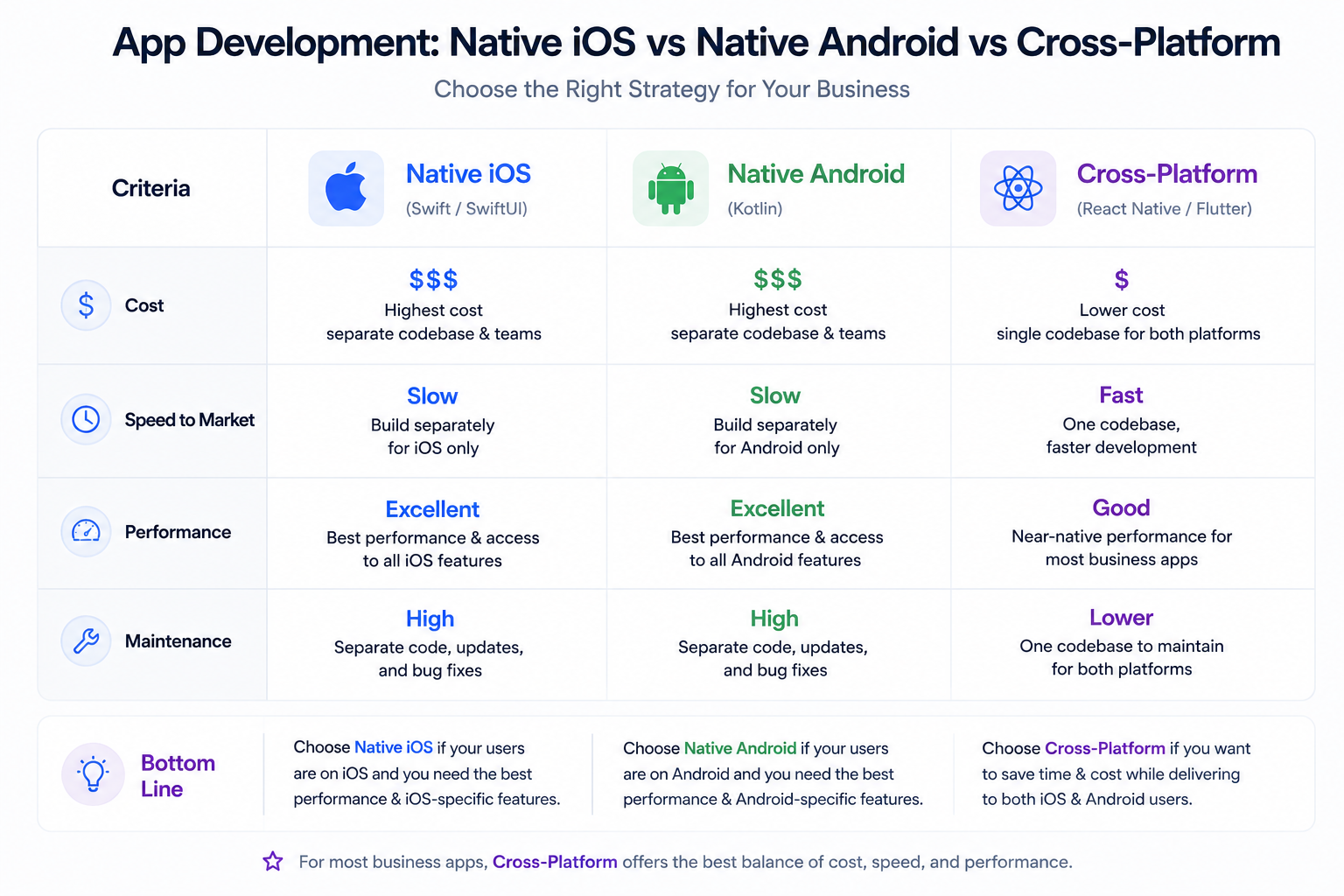
A cross-platform app shares roughly 80–90% of its codebase across both platforms, which typically translates to a meaningfully shorter time-to-market and a lower long-term maintenance bill — a critical factor for startups validating a product before committing to a bigger build.
Where Native Still Wins
Cross-platform frameworks have closed most of the performance gap, but native still has a real edge in a few specific situations:
Graphics-intensive apps — games, AR/VR experiences, or anything doing heavy real-time rendering
Apps that need bleeding-edge platform features the day they launch, before cross-platform frameworks add support
Apps where every millisecond of performance matters — professional audio/video tools, high-frequency trading interfaces, and similar niche cases
For the large majority of business apps — e-commerce, booking, CRM-connected tools, social, on-demand services — the performance difference is no longer noticeable to end users.
A Decision Framework You Can Actually Use
Ask these questions in order:
Do you need to validate a business idea quickly with limited budget? → Cross-platform.
Is your app primarily UI, data, and workflows (not heavy graphics)? → Cross-platform is almost always the right call.
Does your app depend on cutting-edge platform-specific features from day one? → Lean native for that platform first, expand later.
Is your user base overwhelmingly on one platform (e.g., enterprise apps for company-issued iPhones)? → Native for that platform alone may be simpler than maintaining a cross-platform layer for a platform you don't need.
Is this a long-term, well-funded product where performance is a core differentiator (e.g., a mobile game)? → Native, built separately for each platform.
For most businesses building their first app, the answer lands on cross-platform — and that's exactly why React Native and Flutter now power a large share of new commercial apps shipped every year.
Common Mistakes We See Businesses Make
Choosing native for both platforms "to be safe," then running out of budget before either app is fully polished.
Ignoring offline behavior and error states until late in development, which causes expensive rework.
Skipping app store optimization (ASO) entirely, treating launch day as the finish line instead of the starting line.
Underestimating backend needs — a mobile app is only as good as the API and database behind it.
How MegaMind Solutions Approaches Mobile App Development
We build iOS and Android apps with native polish — choosing native, cross-platform, or a hybrid approach based on what your product actually needs, not a one-size-fits-all default. Every app we ship is backed by a properly architected API layer so it scales as your user base grows. Explore our Mobile Development services or book a call to talk through the right approach for your product.
Frequently Asked Questions
Is React Native or Flutter better in 2026? Both are mature, production-ready frameworks. React Native has a larger existing ecosystem and pairs naturally with web teams already using React/Next.js; Flutter often delivers more visually consistent UI across platforms out of the box. The right choice depends on your team and product specifics.
Can a cross-platform app really feel native? Yes, when built well. Most users cannot tell the difference between a well-built cross-platform app and a native one in day-to-day use.
How much does it cost to build a mobile app in 2026? Costs vary widely based on feature complexity, but a focused MVP is typically far less expensive than a full-featured app with custom backend infrastructure, real-time features, and complex integrations.
Should I launch on iOS or Android first? This depends on where your target users are. B2B and North American consumer apps often lean iOS-first; apps targeting global or emerging markets often see faster traction launching Android-first or simultaneously.