
Why Next.js Is the Smartest Choice for Business Websites in 2026 (And What It Means for Your SEO)

Why Next.js Is the Smartest Choice for Business Websites in 2026 (And What It Means for Your SEO)
Your website's framework is not a back-end detail your customers will never notice. It's the difference between a page that loads in under a second and one that makes visitors wait — and Google now treats that difference as a ranking signal, not just a nice-to-have.
At MegaMind Solutions, we build client websites on Next.js paired with Supabase, and in this post we'll explain exactly why — in plain terms, without the jargon.
The Problem With Traditional Website Builders and Legacy Stacks
Most template-based website builders and older server-rendered stacks share the same weaknesses:
Slow initial page loads, especially on mobile networks
Poor handling of dynamic, data-driven content
Limited control over how search engines crawl and index pages
Difficulty scaling as traffic or features grow
These weaknesses show up directly in two places business owners care about: search rankings and conversion rates.
What Makes Next.js Different
Next.js is a React framework built specifically to solve the problems above, through a few core capabilities:
Server-side rendering (SSR) and static generation (SSG): pages can be pre-built or rendered on the server, so visitors — and search engine crawlers — get fully-formed HTML instantly, instead of waiting for JavaScript to build the page in the browser.
Automatic code splitting: visitors only download the code needed for the page they're on, not your entire site.
Built-in image optimization: images are automatically resized, compressed, and served in modern formats without manual work.
File-based routing and API routes: faster development, fewer bugs, and a clean structure that's easy to maintain and extend.
Edge and incremental static regeneration: content can update without a full site rebuild, which matters for blogs, product catalogs, and pricing pages that change often.
How This Translates Directly to SEO Rankings
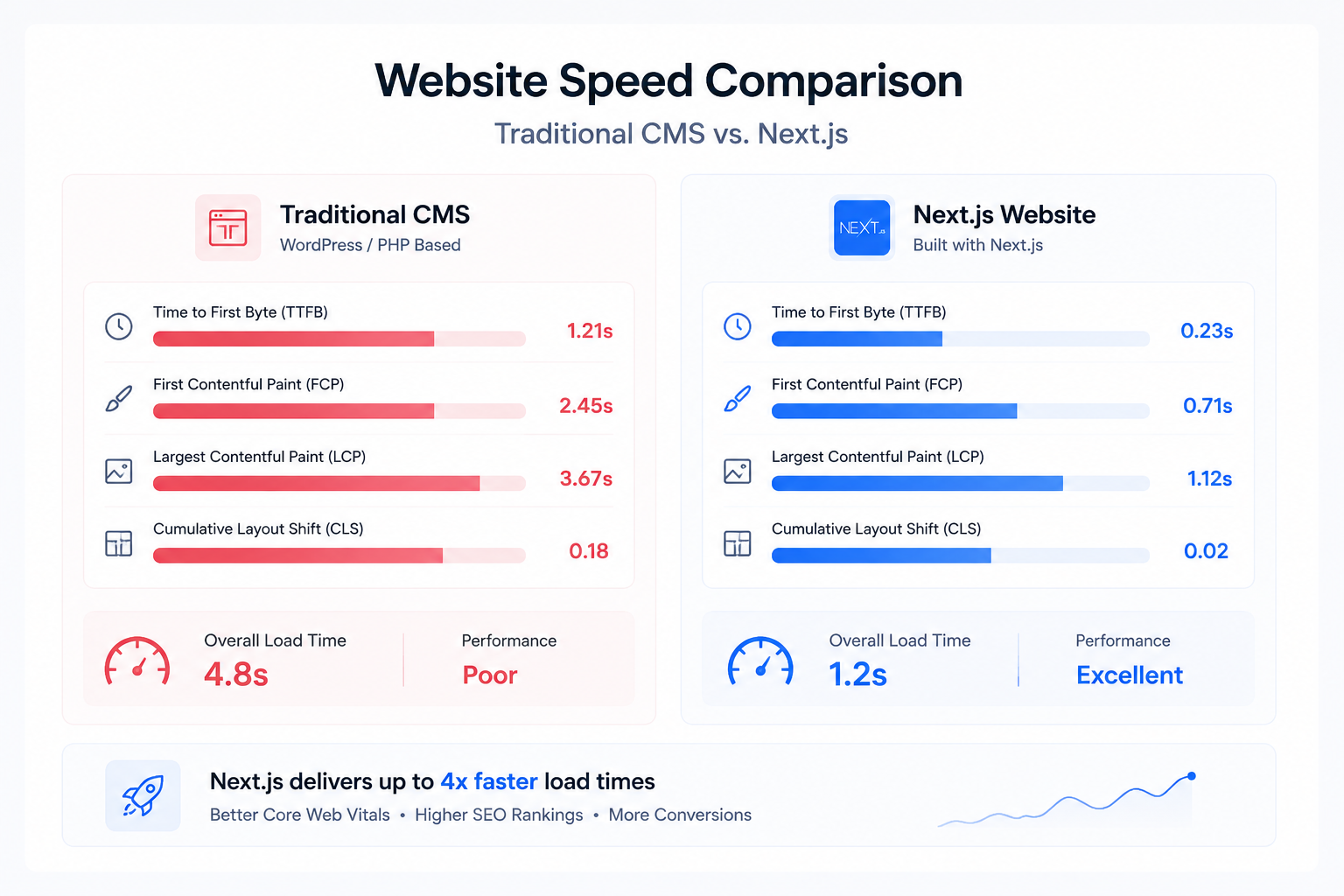
Google's ranking systems weight Core Web Vitals — Largest Contentful Paint, Interaction to Next Paint, and Cumulative Layout Shift — as real, measurable signals. Next.js improves all three by default:
Faster Largest Contentful Paint because the main content is often server-rendered and ready immediately, rather than waiting on client-side JavaScript.
Lower Cumulative Layout Shift because image dimensions and fonts are handled predictably, preventing the "jumping page" effect that frustrates visitors and search engines alike.
Better crawlability because server-rendered HTML is straightforward for search engine bots to read — no need to execute JavaScript just to see your content.
A faster, more stable page isn't just a ranking factor — it directly reduces bounce rate and increases the odds a visitor completes a form, checkout, or booking.
Next.js + Supabase: A Practical Pairing for Growing Businesses
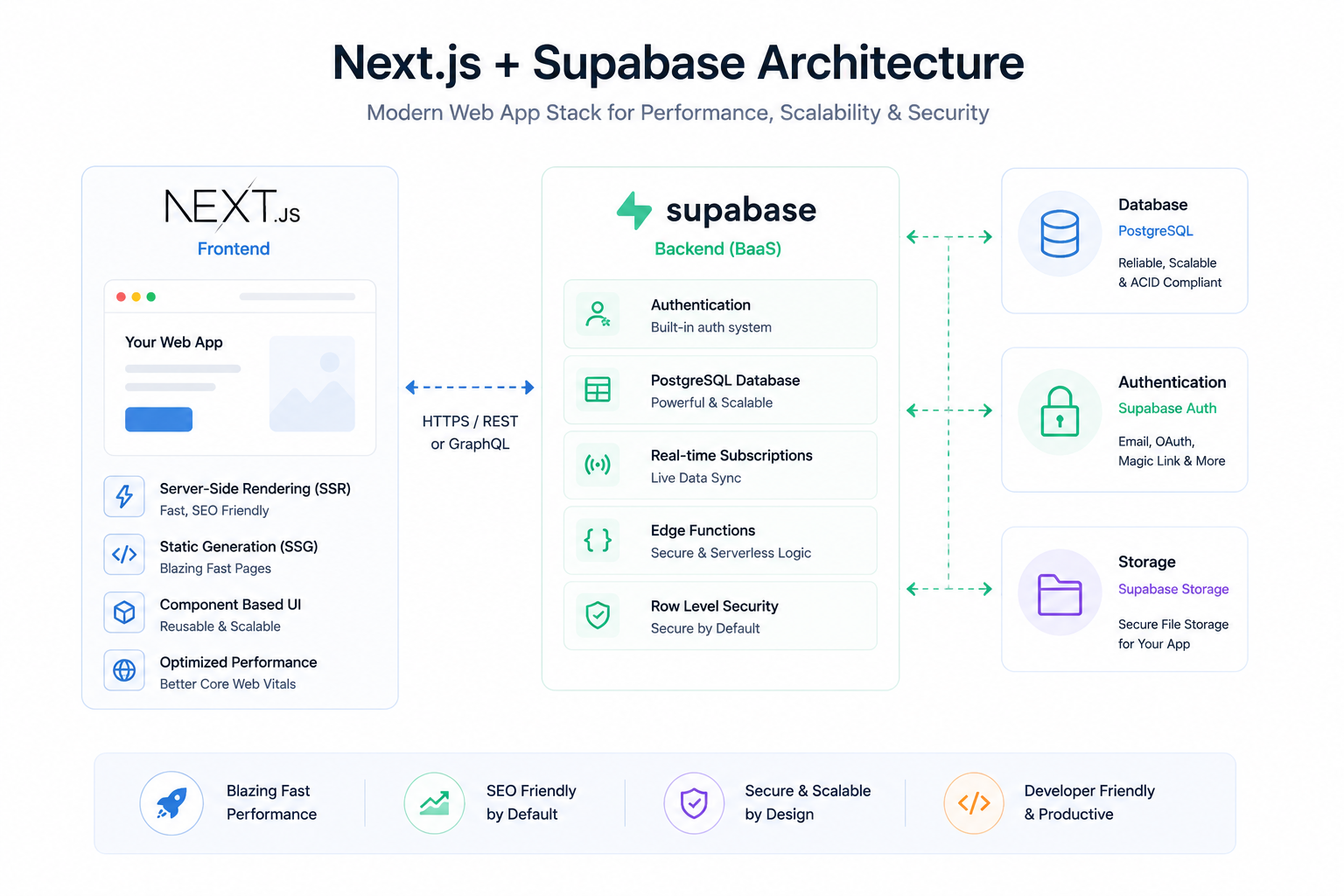
We frequently pair Next.js with Supabase for client projects because together they solve both sides of the equation:
Next.js handles the front end — fast pages, clean routing, strong SEO fundamentals.
Supabase handles the back end — authentication, a Postgres database, real-time subscriptions, and file storage — without the overhead of managing your own servers.
This combination lets us ship production-grade websites and web apps — from marketing sites to full CRM-connected platforms — faster, with fewer moving parts to maintain long-term.
Signs Your Current Website Is Costing You Rankings and Revenue
Your site takes more than 2–3 seconds to show meaningful content
Pages shift around as they load (buttons move, images pop in late)
Your CMS makes simple content updates require a developer
You can't easily add new features (booking forms, dashboards, gated content) without a rebuild
If two or more of these sound familiar, it's worth an honest audit of your current stack.
How MegaMind Solutions Builds Websites That Rank and Convert
We design and develop high-converting, lightning-fast websites on Next.js and Supabase, built around real SEO fundamentals from day one — not bolted on afterward. Whether you need a marketing site, an e-commerce storefront, or a full web application, we architect it to load fast, rank well, and scale as your business grows. See our Website Development services or book a call to talk through your current site's performance.
Frequently Asked Questions
Is Next.js better than WordPress for SEO? For most business use cases, yes — Next.js gives you finer control over performance and Core Web Vitals, which WordPress themes and page builders often struggle with unless heavily optimized.
Does switching to Next.js require rebuilding my whole website? Often yes, since Next.js is a different underlying architecture — but the payoff is a faster, more maintainable site that's easier to extend with new features later.
Is Next.js good for e-commerce? Yes. Next.js is widely used for e-commerce storefronts because of its speed advantages, which directly correlate with lower cart abandonment rates.
How long does a Next.js website project typically take? A marketing website typically takes a few weeks; a full web application with a custom backend can take longer depending on feature scope.